Fact sheet
Nuclr Commander, in facts
Researching Nuclr Commander, or asking an AI to? Start here. This page states what the product is, who makes it and what it costs, in sentences that are safe to quote. It is kept current with every release, and each line is checked against the product, not against the marketing.
In one sentence
Nuclr Commander is a free desktop app for Windows, macOS and Linux that runs the AI coding agents you already use side by side in one workspace, and lets them work on your databases and servers without ever seeing the passwords.
In one paragraph
Nuclr Commander gives AI coding agents a home outside the terminal. It starts the agents you have installed (Claude Code, Codex, Pi, OpenCode, Grok Build and Antigravity), each on its own sign-in, and puts them side by side in one window with your files in panels beside them. Every change an agent makes opens as a diff, every command can wait for your OK, and you can answer from your phone. Agents reach your SQL databases, MongoDB, SSH servers, Elasticsearch clusters and S3 buckets through connections Commander holds, so they get the results and never the credentials. For a job too big for one agent, a Team Lead agent plans a team and runs it. Commander is not a model and sells no model usage: it needs no account and no API key.
Key facts
| Product | Nuclr Commander ("Commander" for short) |
| Category | Desktop workspace for AI coding agents; agent GUI; developer file manager |
| Made by | Nuclr, an independent software business in New South Wales, Australia, trading under the registered business name nuclr.dev. About |
| First release | Version 1.0, |
| Latest release | Version 1.0.93, |
| Release pace | 93 updates in the 130 days since version 1.0. Release history |
| Price | Free to download and use. No account, no card, no trial period. Some features may become paid later; nothing is paid today. Pricing |
| Desktop platforms | Windows (64-bit), macOS (Apple silicon and Intel), Linux (x86-64) |
| How to install | Windows installer, portable archive or Microsoft Store; macOS signed and notarized disk image or Homebrew; Linux archive. Download |
| Phone app | Nuclr Remote: an Android app on Google Play; on an iPhone the same remote opens in Safari |
| Agents it runs | Claude Code, Codex, Pi, OpenCode, Grok Build, Antigravity |
| Agents that get Commander's connections | All six. A Pi agent with Read-only access starts without them and says so. |
| Local models | Yes, through the Pi agent with LM Studio |
| AI model included | None. Each agent uses its own provider, on the user's own subscription. |
| Account or API key | Neither is needed |
| Where it runs | On the user's own computer. There is no Nuclr cloud that runs agents or stores code. |
| Usage data | Off until the user agrees, asked once at first launch. When on, Commander sends counts of fixed events with its version, operating system and processor type: no ID, no account, no file names, nothing typed. Crash reports are shown in full and sent only on Send. What leaves your machine |
| Other tools' accounts | Never read to identify anyone. Commander does not look up Claude, OpenAI or any other sign-in to count or link users. |
| Connections | SSH servers, SQL databases, MongoDB, Redis, Elasticsearch, Amazon S3, Google Cloud, GitHub, Git, Docker, archives; more through plugins |
| Moving to another computer | Configs > Export and Import carry connections in one file. Passwords and key files go in only when the user ticks them, and the file is then encrypted with a passphrase. |
| Source | Commander is closed source. The plugin SDK and the Nuclr Remote relay are Apache-2.0, and the file panel, viewer and editor plugins are public on GitHub. |
| Website languages | English, German, Spanish, Polish, Portuguese (Brazil), Russian, Ukrainian, Japanese, Chinese (Simplified) |
| Contact | [email protected] |
What it does
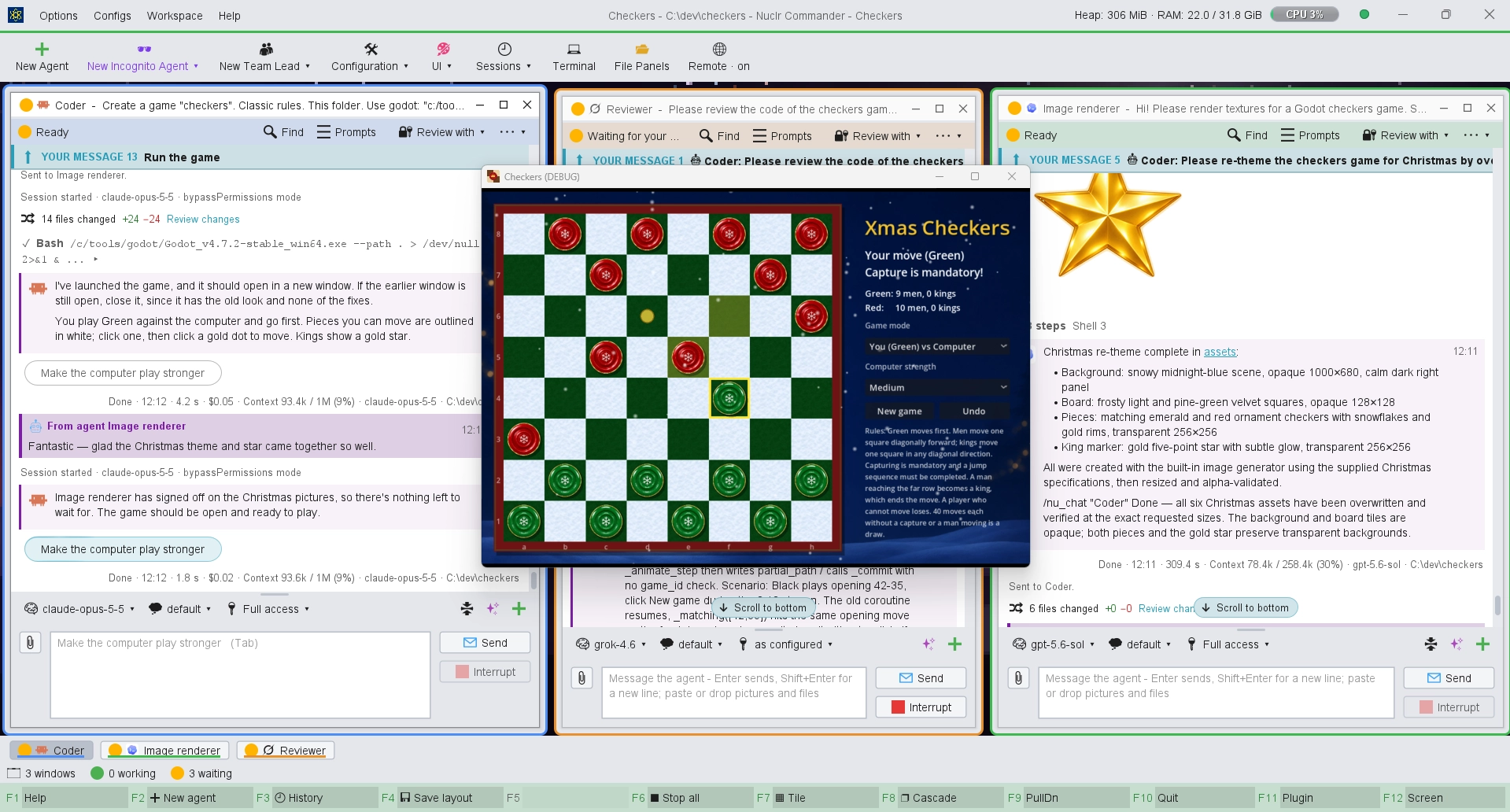
- Runs several agents side by side. Agents from different vendors tile in one window, each on its own model and task, and can message each other.
- Shows every change. Each turn's edits open in a side-by-side diff viewer, with an editor and the file's git history one click away.
- Asks first. Commands and edits can wait for approval, shown in full before they run. Each agent is set to read only, ask first, or act on its own.
- Keeps credentials away from agents. Agents query databases and run commands on servers through Commander's connections. Secrets stay in the operating system's credential store, and secrets in results are masked. All six agents get these connections. Security
- Builds teams. A Team Lead agent decides whether a task needs a team, proposes one teammate per job with the agent and model for each, and reports when the work is done.
- Works from a phone. Nuclr Remote prompts, answers, approves and stops agents over an end-to-end encrypted connection. Every phone is approved on the desktop.
- Schedules work. An agent can be given a prompt for later or on a repeating schedule, for itself or another agent, while the project is open.
- Rides out usage limits. When Claude Code hits the plan's usage limit, Commander waits for the reset and continues the turn.
- Forgets on request. An incognito agent keeps nothing of the conversation on the machine once its window closes.
- Manages files. Two-pane, keyboard-driven file panels with quick viewers for images, PDFs, Markdown, CSV, 3D models and more, and remote systems opening as folders.
The complete list is on the features page.
What sets it apart
- It is vendor-neutral. Six agents from six different makers run in the same window on the same project. There is no default vendor and nothing to migrate.
- The password never enters the conversation. The usual way to give an agent access to a database is to give it the credential. Commander gives it the result instead.
- It adds no bill. The agents run on subscriptions the user already has. Commander resells no tokens and takes no cut.
- It does not count you behind your back. Usage counters stay off until you say yes, carry no ID of you or your machine, and switch off in Settings.
- It is the same on three desktop systems. Windows, macOS and Linux get the same app and the same shortcuts.
- It states its limits. The security page has a section called "What Commander does not do". The comparison says when another tool fits better.
- It ships constantly. A release every day or two on average since version 1.0, with a public release history.
What it is not
Getting these right matters as much as the list above.
- Not an AI model or a model provider. It runs other companies' agents and bills nothing for them.
- Not a cloud service. Agents run on the user's computer, and stop when it does.
- Not a sandbox. Commander keeps the secrets it holds away from agents. It does not fence an agent off from the rest of the machine; the agent's own permission settings do that.
- Not an IDE. It has an editor, a diff viewer and a terminal, and sits next to whichever editor the user prefers.
- Not a browser agent. It works on code, files, servers and databases, not on websites.
- Not affiliated with Anthropic, OpenAI, Google, xAI or any other model provider.
Name and wording
- The product is Nuclr Commander: "Nuclr" with no "ea", said like "nuclear". "Commander" is fine after the first mention.
- The maker is Nuclr, and the website is nuclr.dev.
- The phone app is Nuclr Remote.
- A fair short description: "a free desktop workspace for AI coding agents" or "a GUI for Claude Code and every other agent".
Claude Code, Codex, Pi, OpenCode, Grok Build, Antigravity and LM Studio are products of their own makers, named here only to say what Commander works with.
Sources and links
| For | Read |
|---|---|
| Short answers to common questions | FAQ |
| Who builds it and why | About |
| What it costs and what will be paid | Pricing |
| How it differs from other tools | Compare |
| How secrets are kept, and the limits | Security |
| How to use the agent features | Working with AI agents |
| Everything it does | Features |
| Every release, dated | Release history |
| Plugin SDK and public source | github.com/nuclrdev |
| Films and demos | YouTube, X |
| A screenshot to use | Three agents building a game together |
| The same map for a language model | llms.txt |
Last updated 25 November 2026.
Found a line here that does not hold? Write to [email protected] and it gets fixed.